

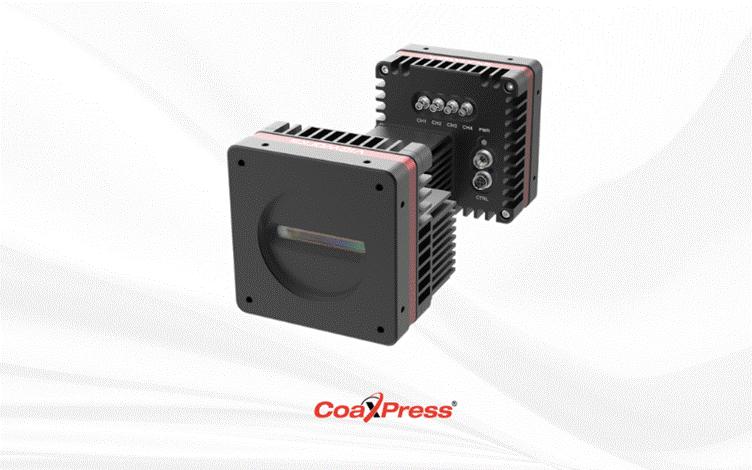
Industrial environments rely on high-quality imaging for inspection, monitoring, and automation. Poor lighting conditions challenge traditional image sensors, leading to noise, reduced contrast, and inaccurate readings. A BSI sensor addresses these issues by capturing more light, improving efficiency in industrial imaging applications.
Standard sensors use a front-side illuminated (FSI) structure, placing wiring and circuitry in front of the photodiode. This design obstructs incoming light, reducing sensitivity. A BSI sensor flips this structure, allowing light to reach the photodiode directly. Increased light absorption enhances performance in low-light conditions, making it suitable for applications requiring precision.
Enhancing Low-Light Performance with BSI Sensors
Industries operating in low-light settings require imaging technology capable of capturing fine details. BSI sensor technology reduces light obstruction, improving quantum efficiency and reducing noise levels. More efficient light collection ensures clearer images with enhanced contrast and sharpness.
Low-light imaging is critical for sectors such as manufacturing, logistics, and security. Quality control in automated production lines depends on sensors that deliver precise image data. Security systems monitoring industrial facilities benefit from sensors capable of operating efficiently in minimal lighting. A BSI sensor ensures accuracy in these applications by enhancing light sensitivity and reducing signal interference.
Reducing Noise for Accurate Image Capture
Noise in imaging degrades quality, leading to incorrect analysis in industrial settings. Poor lighting conditions amplify noise, making details difficult to distinguish. A BSI sensor mitigates these issues by minimising signal interference and optimising the signal-to-noise ratio.
Traditional sensors introduce electronic noise as light signals pass through multiple layers before reaching the photodiode. A BSI sensor reduces interference by positioning the photodiode closer to the light source, enhancing clarity. Reduced noise improves image accuracy, benefiting industrial applications such as machine vision, automated inspections, and robotic guidance.
Increasing Sensitivity for Precision Imaging
Industrial imaging demands high sensitivity to detect fine details in challenging conditions. Standard sensors struggle with efficiency in dim environments, leading to errors in image processing. A BSI sensor maximises sensitivity by increasing light absorption, ensuring consistent performance in industrial applications.
Quality assurance in manufacturing requires precise imaging to detect defects, inconsistencies, and irregularities. Automated production lines equipped with BSI sensor technology improve efficiency by delivering clearer visuals. Improved sensitivity also benefits industries using infrared imaging, thermal monitoring, and surveillance systems that operate in challenging environments.
Enhancing Machine Vision Applications
Machine vision plays a crucial role in industrial automation, enabling systems to process visual data for decision-making. The effectiveness of machine vision depends on image quality, particularly in environments with varying light levels. A BSI sensor enhances image capture, ensuring reliability in automated systems.
Industries using robotic arms, conveyor belt inspections, and automated sorting systems require high-resolution imaging. A BSI sensor enhances machine vision by providing sharper images, reducing processing errors, and improving detection capabilities. Increased light efficiency allows automated systems to function with greater accuracy, even in environments with poor lighting.
ALSO READ: BSI vs FSI Sensors: Which Sensor Suits Your Needs?
Supporting Security and Surveillance Systems
Industrial facilities depend on surveillance systems to monitor operations, detect security threats, and prevent unauthorised access. Poor lighting conditions compromise the effectiveness of security cameras, making it difficult to capture clear footage. A BSI sensor improves performance in low-light settings, ensuring surveillance systems operate efficiently.
Enhanced sensitivity enables security cameras to produce clearer images in warehouses, production plants, and restricted areas. A BSI sensor reduces motion blur and enhances contrast, allowing security personnel to identify objects, individuals, and activities with greater accuracy. Reliable low-light imaging strengthens facility security, improving response times and reducing risks.
Improving Performance in Harsh Industrial Environments
Industrial settings expose imaging equipment to challenging conditions, including low lighting, high temperatures, and exposure to dust or chemicals. Standard sensors often struggle with performance under these circumstances, leading to inconsistencies in image capture. A BSI sensor maintains stability in harsh environments, ensuring consistent operation.
Improved light sensitivity allows industrial sensors to function effectively despite environmental limitations. Manufacturing plants, warehouses, and outdoor facilities benefit from sensors designed to operate reliably under extreme conditions. A BSI sensor provides stable performance, reducing maintenance requirements and improving long-term efficiency.
Choosing the Right BSI Sensor for Industrial Use
Selecting a BSI sensor for industrial applications depends on factors such as resolution, frame rate, and compatibility with existing systems. High-resolution sensors provide greater detail, while faster frame rates improve performance in dynamic environments. Understanding specific industrial requirements ensures the selection of the most suitable sensor for optimal performance.
Industrial imaging solutions benefit from sensors designed for durability and efficiency. Ensuring compatibility with machine vision systems, security cameras, and automated inspection equipment maximises the advantages of BSI sensor technology. Evaluating sensor specifications, lighting conditions, and operational demands helps industries make informed decisions when integrating BSI sensor technology.
Conclusion
A BSI sensor enhances image quality in low-light industrial environments, improving efficiency in machine vision, surveillance, and automated processes. Increased sensitivity, reduced noise, and enhanced performance enable industries to achieve precise imaging under challenging conditions. Choosing the right BSI sensor ensures reliability and accuracy in industrial applications.
Visit or contact Voltrium Systems for BSI sensor solutions and more industrial sensors designed to enhance imaging performance in demanding environments.
